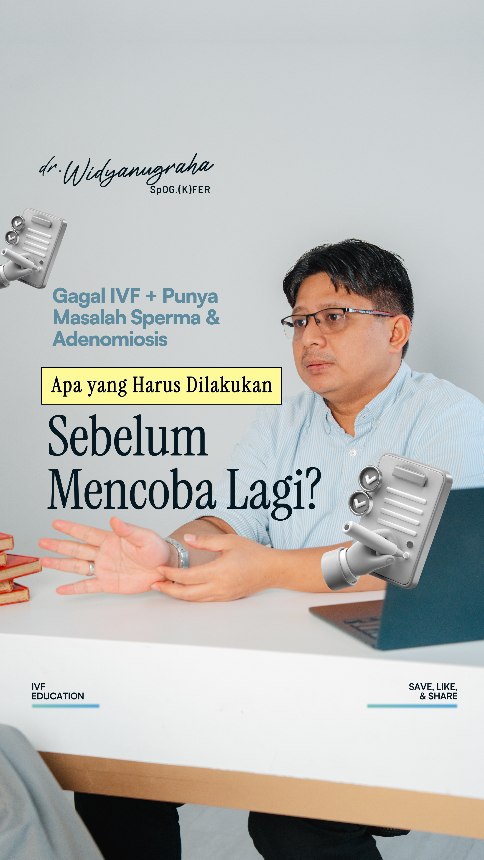
IVF Berulang Gagal: Evaluasi Sperma dan Adenomiosis Sebelum Coba Lagi Repeated IVF Failure: Evaluating Sperm Issues and Adenomyosis Before Your Next Attempt

Sudah menjalani IVF berkali-kali namun belum berhasil? Kenali peran mikrodelesi kromosom Y, severe OAT, dan adenomiosis dalam kegagalan implantasi.Multiple IVF cycles without success? Learn how Y-chromosome microdeletion, severe OAT, and adenomyosis can affect implantation and what can be optimised next.

IVF Berulang Gagal: Evaluasi Sperma dan Adenomiosis Sebelum Coba Lagi

Ketika IVF Berulang Kali Belum Membuahkan Hasil

Menjalani program bayi tabung lebih dari sekali tanpa keberhasilan adalah pengalaman yang berat secara emosional maupun fisik. Namun, kegagalan berulang bukan berarti peluang sudah tertutup sepenuhnya. Seringkali, ada faktor-faktor spesifik yang belum teridentifikasi atau belum dioptimalkan secara menyeluruh — dan inilah yang perlu dievaluasi sebelum memutuskan langkah berikutnya.

Faktor dari Pihak Suami: Mikrodelesi Kromosom Y dan Severe OAT

Keberhasilan IVF tidak hanya ditentukan oleh kondisi istri. Kualitas sperma memegang peranan yang sama pentingnya. Salah satu kondisi yang perlu mendapat perhatian serius adalah mikrodelesi kromosom Y, yaitu hilangnya segmen kecil pada kromosom Y yang berperan dalam produksi sperma. Kondisi ini dapat menyebabkan gangguan spermatogenesis yang bersifat permanen maupun progresif.

Selain itu, severe OAT (oligoasthenoteratozoospermia) — kondisi di mana jumlah, motilitas, dan morfologi sperma semuanya berada di bawah nilai normal — dapat memengaruhi kemampuan sperma untuk membuahi sel telur meskipun prosedur ICSI sudah dilakukan. Pada situasi seperti ini, salah satu strategi yang dapat dipertimbangkan oleh dokter adalah melakukan pembekuan (cryopreservation) sperma terlebih dahulu. Tujuannya adalah memastikan ketersediaan sperma terbaik yang dapat digunakan pada saat dibutuhkan, sehingga proses IVF tidak terhambat oleh ketidakpastian kondisi sperma di hari pengambilan sel telur.

Faktor dari Pihak Istri: Adenomiosis dan Reseptivitas Endometrium

Di sisi istri, kondisi seperti adenomiosis — di mana jaringan yang menyerupai lapisan dalam rahim tumbuh ke dalam dinding otot rahim — perlu mendapat perhatian khusus dalam konteks IVF. Adenomiosis umumnya tidak secara langsung menurunkan kualitas sel telur, namun dapat berdampak signifikan pada reseptivitas endometrium, yaitu kemampuan lapisan rahim untuk menerima dan menopang embrio yang akan menempel.

Gangguan pada reseptivitas endometrium ini bisa menjadi alasan mengapa embrio yang secara kualitas tampak baik tetap gagal berimplantasi. Oleh karena itu, menangani adenomiosis sebelum transfer embrio dilakukan merupakan bagian penting dari strategi pengobatan yang komprehensif.

Strategi Freeze-All: Mengoptimalkan Kondisi Rahim Sebelum Transfer

Dalam kondisi tertentu, dokter dapat merekomendasikan pendekatan freeze-all strategy. Pada strategi ini, seluruh embrio yang berhasil terbentuk dibekukan terlebih dahulu. Transfer embrio tidak dilakukan pada siklus yang sama, melainkan dijadwalkan setelah kondisi rahim — termasuk penanganan adenomiosis — telah dioptimalkan.

Pendekatan ini memberikan waktu bagi tubuh untuk pulih dan mempersiapkan lingkungan rahim yang lebih kondusif bagi implantasi. Keputusan untuk menggunakan strategi ini sangat bergantung pada kondisi klinis masing-masing pasien dan merupakan hasil diskusi mendalam antara pasien dan dokter spesialis fertilitas.

Evaluasi Menyeluruh Adalah Kunci

Setiap pasangan yang menjalani IVF memiliki kombinasi tantangan yang unik. Tidak ada satu pendekatan yang berlaku untuk semua. Itulah mengapa evaluasi yang menyeluruh dan strategi yang dipersonalisasi menjadi fondasi dari setiap rencana pengobatan yang efektif. Mulai dari analisis genetik sperma, pemeriksaan lanjutan pada rahim, hingga penilaian embrio secara mendalam — setiap data membantu dokter merancang langkah yang paling tepat untuk kondisi Anda.

Jika Anda atau pasangan sudah menjalani IVF beberapa kali namun belum berhasil, jangan menyerah sebelum mendapatkan evaluasi yang komprehensif. Tim dokter ASHA IVF Indonesia di Surabaya siap membantu Anda memahami apa yang terjadi dan merancang strategi terbaik untuk langkah berikutnya. Hubungi kami melalui WhatsApp untuk memulai konsultasi personal bersama dokter spesialis fertilitas kami.

Terinspirasi dari aktivitas Instagram @ashaivfindonesia. Lihat unggahan aslinya →

When IVF Has Been Tried Multiple Times Without Success

Going through multiple IVF cycles without achieving a pregnancy is an emotionally and physically exhausting experience. Yet repeated failure does not mean all hope is lost. In many cases, there are specific factors that have not yet been fully identified or optimised — and uncovering these is the essential first step before deciding how to move forward.

The Male Factor: Y-Chromosome Microdeletion and Severe OAT

IVF success is not determined by the woman's condition alone. Sperm quality plays an equally critical role. One condition that deserves careful attention is Y-chromosome microdeletion — the loss of small segments on the Y chromosome that are responsible for sperm production. Depending on which region is affected, this can lead to progressive or permanent impairment of spermatogenesis.

Compounding this, severe OAT (oligoasthenoteratozoospermia) — a condition in which sperm count, motility, and morphology are all significantly below normal — can compromise fertilisation even when ICSI is performed. In such situations, a doctor may recommend sperm cryopreservation ahead of the IVF cycle. Freezing sperm in advance ensures that the best available sample is secured and ready when the egg retrieval takes place, eliminating uncertainty on the day of the procedure.

The Female Factor: Adenomyosis and Endometrial Receptivity

On the woman's side, a condition such as adenomyosis — where tissue resembling the uterine lining grows into the muscular wall of the uterus — requires careful consideration in the context of IVF. Adenomyosis does not typically reduce egg quality directly, but it can have a meaningful impact on endometrial receptivity: the uterine lining's capacity to welcome and sustain an implanting embryo.

This disruption in receptivity may explain why embryos that appear to be of good quality still fail to implant. Addressing adenomyosis before embryo transfer is therefore an important component of a well-rounded treatment plan.

The Freeze-All Strategy: Preparing the Uterus Before Transfer

Under certain clinical circumstances, a fertility specialist may recommend a freeze-all strategy. Rather than transferring embryos in the same stimulation cycle, all viable embryos are cryopreserved. The transfer is then scheduled for a subsequent cycle, once the uterine environment — including any necessary management of adenomyosis — has been properly optimised.

This approach gives the body time to recover and creates a more favourable setting for implantation. The decision to pursue this strategy is highly individualised and is made collaboratively between the patient and her fertility doctor based on a thorough review of her clinical picture.

Comprehensive Evaluation Is the Foundation of the Next Step

Every couple facing infertility presents with a unique combination of challenges. There is no single protocol that fits everyone. This is precisely why thorough evaluation and a personalised treatment strategy are so central to effective fertility care. From genetic analysis of sperm and advanced uterine investigations to detailed embryo assessment — each piece of information helps the specialist design the approach most likely to succeed for your specific situation.

If you have already undergone several IVF cycles without the outcome you hoped for, please do not give up before seeking a comprehensive second opinion. The specialist team at ASHA IVF Indonesia in Surabaya is ready to help you understand what may be influencing your results and to build a tailored plan for your next attempt. Reach out to us via WhatsApp to begin a personal consultation with our fertility specialists.

Terinspirasi dari aktivitas Instagram @ashaivfindonesia. Lihat unggahan aslinya →

Kembali ke ArtikelBack to Articles
Chat WhatsAppChat WhatsApp